Vaping vs Nicotine Pouches: Which Smoke-Free Option Is Right for You?
Ask a room of ex-smokers how they finally quit and you’ll increasingly hear two answers competing: vaping, and nicotine pouches. Both are smoke-free, both deliver nicotine effectively, and both have converted people who’d failed with everything else — but they are wildly different experiences, and the choice between them shapes your whole day-to-day relationship with nicotine. One keeps the ritual of smoking alive in your hand; the other makes nicotine completely invisible. This article is the honest head-to-head: how each actually works, where each wins, how they compare on cost, discretion, satisfaction and health, and — crucially — why you don’t necessarily have to choose just one. If you’re weighing up your smoke-free options in 2026, this is the comparison that cuts through the noise.
How Each One Works
Start with the mechanics, because they explain everything downstream. Vaping heats e-liquid into an inhalable vapour: you draw on a device, the nicotine absorbs through your lungs, and you exhale a visible cloud. The experience closely mimics smoking — same hand-to-mouth motion, same inhale, same throat sensation — which is precisely why it works so well for people replacing the physical habit of cigarettes. Nicotine pouches work through the mouth instead: you place a small tobacco-free pouch under your upper lip, and nicotine absorbs through the gum tissue over twenty minutes to an hour. No inhaling, no smoke, no vapour, no hands once it’s in. The two could hardly be more different in feel: vaping is active and ritualistic, pouches are passive and hidden. Neither is objectively superior — they simply suit different people and different situations.
Round One: Discretion
This is pouches’ clearest win. A nicotine pouch is completely invisible in use — no cloud, no smell, no sound, no hand movement — which means it can be used in places vaping simply can’t: a meeting, a flight, a cinema, a no-vaping office, mid-conversation. For anyone whose day contains lots of situations where you can’t step outside or produce a visible cloud, that discretion is genuinely transformative. Vaping, even at its most modest, produces vapour and requires a hand-to-mouth action, and while techniques exist to minimise it, it will never be truly invisible. If discretion is high on your list — and for many desk-workers, travellers and parents it’s the single biggest factor — pouches take this round comfortably. Vaping’s answer is that its visibility is also part of its satisfaction, which brings us to the next round.
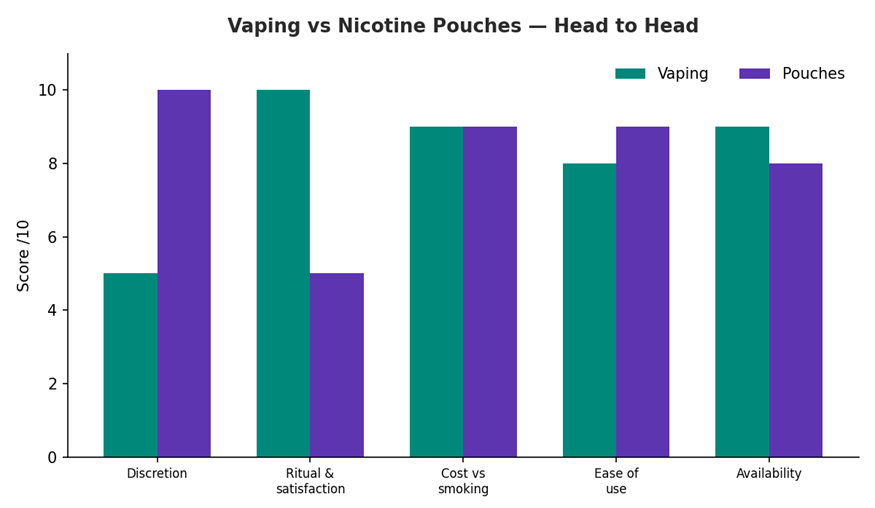
Vaping vs nicotine pouches — a head-to-head across the factors that decide the choice.
Round Two: Ritual and Satisfaction
Here vaping pushes back hard. The reason vaping succeeds as a switching tool where patches and gum often fail is that it replaces the behaviour of smoking, not just the nicotine — the hand-to-mouth ritual, the pause, the inhale and exhale. For many ex-smokers, that ritual was half the addiction, and a product that preserves it is far easier to switch to. Pouches deliver nicotine effectively but ask you to give up the ritual entirely, which some people find they don’t miss and others find leaves a behavioural gap. There’s also the matter of the ‘hit’: vaping’s throat sensation and immediate feedback feel more like smoking, while pouches deliver a slower, steadier absorption that some prefer and others find too subtle at first. If replacing the act of smoking matters to you, vaping wins this round — and for heavy smokers specifically, that behavioural replacement is often decisive.
Round Three: Cost
Both demolish the cost of smoking, so this round is about the margins. Vaping’s cost depends heavily on format: a refillable pod kit with bottled e-liquid is extremely cheap per day, while prefilled pod kits sit a little higher for the convenience. Pouches are priced per tin of pouches, and daily cost depends on how many you use and at what strength. In practice the two land in broadly similar territory for a moderate user — both a small fraction of a smoking habit — with refillable vaping edging cheapest and premium pouches sitting at the higher end. Neither is expensive by the standard that matters, which is comparison to cigarettes. The honest verdict: cost is rarely the deciding factor between them, because both save you so dramatically versus smoking that the difference between them is rounding error by comparison.
Round Four: Health Considerations
Here caution and honesty both matter. Neither product is risk-free — both contain nicotine, which is addictive and not benign, particularly for the young, pregnant, or those with certain conditions. But both are widely regarded by UK public health bodies as substantially less harmful than smoking, because both eliminate combustion — the burning that produces the tar and thousands of chemicals responsible for smoking’s devastation. Between the two, the research picture is still developing, and neither has the decades-long evidence base that would allow confident fine distinctions; both remove the smoke, which is the overwhelming majority of smoking’s harm. The sensible framing is that for a smoker, either represents a major harm-reduction step, and the choice between them should rest on which you’ll actually stick with — since the best smoke-free product is the one that keeps you off cigarettes for good.
Why Not Both?
Here’s the option the head-to-head framing obscures: many people use both, strategically, and it’s arguably the smartest approach. Vaping for the ritual moments — the morning coffee, the post-meal pause, the wind-down — where the hand-to-mouth act is part of the satisfaction; pouches for the discreet moments — the meeting, the flight, the office, the situations where a cloud isn’t an option. Used this way, the two products cover each other’s weaknesses completely: vaping’s satisfaction and ritual where you can, pouches’ invisibility where you must. Plenty of ex-smokers settle into exactly this hybrid, and it removes the pressure to pick a single winner. If you’re switching from cigarettes, there’s no rule that says you must choose one lane — the goal is staying off smoking, and a two-tool kit often does that more robustly than either alone.
A Note on Terminology
One quick clarification, because it causes endless confusion in this comparison: nicotine pouches are frequently called ‘snus’, but they aren’t the same thing. Traditional snus contains tobacco and is banned for sale in the UK; the pouches people actually buy and use here are tobacco-free, which is exactly why they’re legal. If you’ve been researching and getting tangled in the terminology, it’s worth reading a proper explainer of what is snus versus the modern nicotine pouch — the distinction is legal and material, not just pedantic, and understanding it saves a lot of confusion when you’re shopping. For this comparison, just know that when we say ‘pouches’, we mean the legal tobacco-free product, not the banned tobacco one the name sometimes implies.
Making Your Choice
So which is right for you? If you most want to replace the physical ritual of smoking and value that hand-to-mouth satisfaction, start with vaping — a simple pod kit is the easiest entry, and modern pod kits are built precisely for switching smokers. If discretion dominates your day and you want nicotine invisibly, start with pouches. If you’re genuinely torn, try both — they’re inexpensive enough to experiment with, and you may well land on a hybrid. The one piece of advice that applies universally: get your nicotine strength right for your habit, because under-dosing is the classic reason any smoke-free switch fails, whichever product you choose. Buy genuine from established UK retailers, give any new product a fair week rather than judging it on day one, and let the goal — staying off cigarettes — guide the choice.
Switching Between the Two
One underappreciated advantage of the modern smoke-free market is how easy it is to switch between vaping and pouches, or to run both, without any of the friction that used to lock people into a single method. If you start with vaping and find you want discretion in certain situations, adding pouches is trivial — no new device, no learning curve, just a tin in your pocket. If you start with pouches and miss the ritual, a simple pod kit brings it back. Many people cycle through both before settling on their preferred balance, and there’s no cost to experimenting given how inexpensive both are relative to smoking. This flexibility means the vaping-versus-pouches question isn’t a high-stakes fork in the road but a low-risk exploration — you can try one, try the other, try both, and let your actual experience rather than a guide’s recommendation decide what fits your life. The only real mistake is not switching away from cigarettes at all.
Getting Started with Either
If this comparison has helped you lean one way, a few starting pointers apply regardless of which you choose. Get your strength right for your smoking habit — under-dosing is the universal reason switches fail, whichever product you pick. Buy a small variety rather than committing to one flavour, since taste is personal and a product you enjoy is one you’ll stick with. Give it a fair week rather than judging on day one, as your senses recalibrate away from smoke. Keep your product where your cigarettes used to live, always available, with a spare on hand. And buy genuine from established UK retailers with proper age verification. These principles apply equally to vaping and pouches, which is a reminder that the specific product matters less than using it properly — the goal is staying off cigarettes, and both tools achieve that well when deployed with a bit of care rather than left to chance.
A Realistic Expectation
Whichever you choose, set a realistic expectation: the first days of any smoke-free product feel slightly unfamiliar, and that’s normal rather than a sign you’ve chosen wrong. Your senses are recalibrating from years of smoke, the sensation is different, and it takes a little time to settle into the new rhythm. Give any product a fair week or two before judging it, and resist the temptation to conclude after a single awkward day that vaping or pouches ‘aren’t for you’. A great many people who could have switched successfully gave up prematurely, mistaking the normal adjustment period for a fundamental mismatch. Patience in the first fortnight is one of the most underrated factors in a successful switch — the products work, but they work on a timescale of weeks as your habits and senses adjust, not on the instant timescale of lighting a cigarette. Trust the process, and give yourself the fair trial that success actually requires.
Frequently Asked Questions
Can I use both vaping and pouches? Yes, and many people do — vaping for ritual moments, pouches for discreet ones. Which delivers nicotine faster? Vaping’s hit is more immediate; pouches release more slowly and steadily. Are pouches the same as snus? No — pouches are tobacco-free and legal, while snus contains tobacco and is banned. Which is cheaper? Both are a fraction of smoking’s cost, roughly comparable, with refillable vaping slightly ahead. Which is better for quitting? Whichever you’ll actually stick with — the best product is the one that keeps you off cigarettes, and for many that’s a combination. Do I need special equipment for pouches? No — unlike vaping, there’s no device, just the pouches themselves, which is part of their appeal for discretion and simplicity.
The Bottom Line
Vaping and nicotine pouches are both excellent smoke-free tools that happen to suit different people and different moments: vaping for ritual and satisfaction, pouches for discretion and invisibility, and often both together for the best of each. Neither is a magic bullet and neither is risk-free, but both represent a major step away from the smoke that does the real damage. Choose by matching the product to the moments in your life where nicotine currently lives, get your strength right, buy genuine, and don’t be afraid to run a two-tool kit. As always: these products are for adults aged 18 and over who already smoke or use nicotine, as far less harmful alternatives to cigarettes — and for anyone else, the best choice in this whole comparison remains neither.