
Youhong Medical Advances Wearable Health Technology Through Biosensing and AI-Powered Insights
With registered medical measurement capabilities, intelligent health monitoring and AI-assisted data analysis, Youhong Medical (J-Style) is demonstrating how connected wearables can support a more comprehensive approach to personal health management.
DÜSSELDORF, Germany — Wearable technology is entering a new phase as smart rings, health bands, biosensors and artificial intelligence become increasingly connected. Rather than focusing on isolated measurements, the latest generation of devices is designed to collect multiple health-related signals and present them through digital platforms that help users understand patterns in their daily health data.
At MEDICA 2026 in Düsseldorf, Germany, Youhong Medical (J-Style) is presenting its wearable technology portfolio, including JCRing smart rings and JCVital smart bands. Visitors can explore the company’s solutions at Hall 7.1, Stand D41-1, where the company is highlighting its work across biosensing, wearable hardware, AI-assisted health insights and connected digital health services.
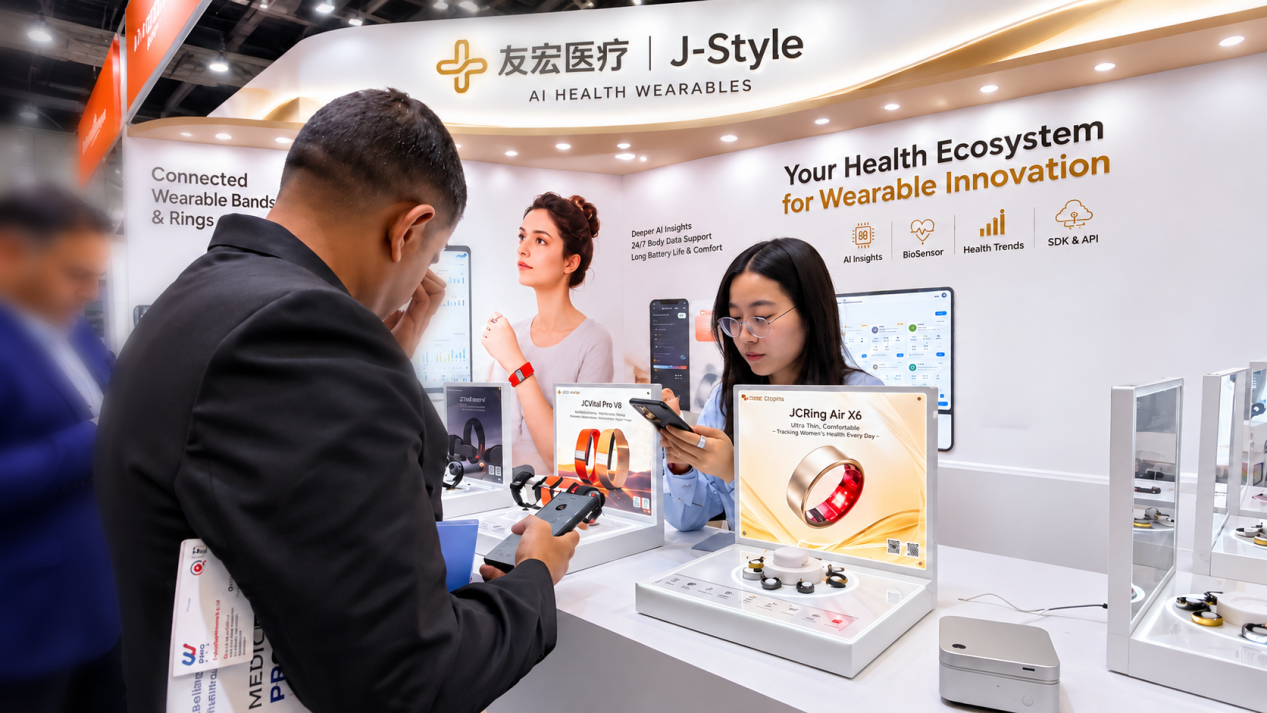
Medical Registration Supports the Development of Smart Health Wearables
An important part of Youhong Medical’s product development is the integration of medical measurement capabilities into compact wearable devices. The JCRing Med X3, for example, offers adult blood oxygen saturation (SpO₂) and pulse-rate measurement functions that have received Class II medical device registration from China’s National Medical Products Administration (NMPA).
This registration applies to the specified measurement functions within the Chinese regulatory framework. It should not be interpreted as EU Medical Device Regulation (MDR) certification or as approval for every feature available through the device.
Beyond these registered functions, the JCRing product family explores additional health-monitoring capabilities, including sleep tracking, sleep apnea risk assessment and AI-assisted blood glucose risk assessment. These features have different purposes and regulatory status from the registered measurement functions. In particular, AI-assisted blood glucose risk assessment does not directly measure glucose and should not replace blood glucose testing, professional medical advice or clinical diagnosis.
By combining compact hardware with multiple sensing and software capabilities, J-Style is working to make health-related information more accessible through everyday wearable devices.
JCRing Smart Rings Focus on Compact and Continuous Monitoring
Smart rings offer an alternative to conventional wrist-worn devices by placing sensors in a small form factor designed for everyday use. The JCRing range is developed around this approach, bringing selected physiological monitoring functions into a wearable format that can be used throughout daily routines.
The product family focuses on areas such as blood oxygen measurement, pulse-rate monitoring and sleep-related insights. Depending on the model and available software features, users can also access additional information intended to help them review patterns in their health and activity data.
The broader objective is to connect wearable measurements with useful digital experiences. Instead of presenting individual readings without context, connected applications can organize historical information and help users observe changes over time. This approach may support personal awareness, although wearable readings should always be interpreted according to the device’s intended purpose and limitations.
JCVital Pro V8 Introduces a Screenless Approach to Health Tracking
Alongside its smart ring portfolio, Youhong Medical is presenting the JCVital Pro V8, a screenless wearable designed to monitor several health and activity indicators.
Its monitoring capabilities include heart rate, heart rate variability (HRV), blood oxygen, sleep, physical activity and stress-related metrics. By collecting information across different areas, the device aims to provide a broader view of daily patterns rather than concentrating on a single measurement.
A key part of the JCVital experience is its Fuel concept, which translates selected health and recovery-related information into a visual format. The aim is to make complex data easier to review and understand through a more accessible presentation.
The device also connects with AI Health Insights, an approach designed to explore relationships between different data points. Weekly and monthly reports allow users to review longer-term trends, compare changes and gain a clearer overview of their recorded activity and wellness information.
As with other consumer wearable technologies, these insights are intended for informational and wellness purposes unless a particular function has received the relevant medical authorization. They are not a substitute for professional medical assessment.
Bringing Biosensors, AI and Digital Services Together
The development of wearable health technology increasingly depends on how effectively hardware, software and data services work together. A sensor may collect physiological information, but the wider user experience depends on how that information is processed, organized and presented.
Youhong Medical is developing its JCVital ecosystem around this connected approach. Its broader portfolio includes smart rings, wearable bands, body-composition monitoring solutions and digital health services. The company’s Body, Bio and AI initiatives reflect its interest in combining physical measurements, biosensing technologies and intelligent data analysis.
Through the JCVital Pro application, users can access visualized health information, review historical records and explore available reports. This connected structure is intended to make collected data easier to follow while supporting a more consistent experience across compatible devices and services.
AI-assisted analysis adds another layer to this process. By examining relationships between different measurements, software can help identify patterns that may be difficult to recognize when reviewing individual readings. However, the usefulness of these insights depends on data quality, appropriate interpretation and clear communication about what the technology can and cannot establish.
Technology Development Extends Beyond Wearable Hardware
Youhong Medical’s work also involves the technical infrastructure required to develop and support connected health products. Its capabilities cover wearable hardware engineering, BioSensor technology, firmware and software development, mobile applications, AI-assisted analysis and cloud-based platforms.
The company also supports SDK and API integration for selected products and projects, allowing compatible wearable solutions to connect with external applications and digital services. Integration options depend on the product, technical requirements and scope of the project.
This broader development model reflects the growing importance of interoperability in the wearable technology market. As health-related devices become part of larger digital ecosystems, manufacturers need to consider not only sensor performance but also software compatibility, data presentation, platform reliability and long-term support.
Reliability, Privacy and Responsible Data Interpretation
As wearable devices collect increasingly detailed information, product reliability and responsible data management remain essential considerations. Accurate measurements, appropriate validation and transparent communication help users understand the intended role of each feature.
Regulatory compliance is another important part of product development. Medical device registration applies to specific products and functions within defined markets, while other wellness and AI-assisted features may operate under different requirements. Clear distinctions help prevent users from confusing general wellness insights with clinically validated measurements.
Privacy and data protection are equally important for connected health platforms. Users should be able to understand how their information is collected, processed and presented. Manufacturers must continue to consider secure data handling and appropriate safeguards as wearable ecosystems expand.
For Youhong Medical, these considerations form part of the wider development of connected wearable solutions that bring together sensing technology, software and digital health services.
Exploring the Next Stage of Connected Wearable Health
The wearable health market is moving toward products that combine multiple sensors with more advanced software and connected applications. Smart rings and screenless bands are expanding the ways people can access health-related information, while AI-assisted tools are creating new possibilities for organizing and interpreting collected data.
Through its JCRing and JCVital product families, Youhong Medical (J-Style) is contributing to this development with a portfolio that spans registered medical measurement functions, wellness monitoring, biosensing and digital health services.
At MEDICA 2026, the company is presenting these technologies to visitors and industry professionals interested in the future of wearable devices and connected health platforms.
For more information about Youhong Medical and its wearable technology solutions, visit the company’s website at jointcorp.com or contact [email protected].
About Youhong Medical (J-Style)
Youhong Medical (J-Style) develops wearable technology and connected digital health solutions, with a focus on smart rings, health bands, biosensing technologies and AI-assisted data services. Its development capabilities include wearable hardware, firmware, software, mobile applications and cloud-based platforms, supporting the creation of connected products for personal health monitoring and digital wellness applications.
