
The Future of Customer Service: Inside AI Call Center Solutions
Customer service has come a long way—from touch-tone menus and long waits to intelligent systems that actually understand what customers need. Businesses are now using AI in call centers to deliver fast, accurate, and personalized support, meeting the expectations of modern customers. These solutions go beyond simple chatbots or automated phone systems. They combine advanced technologies such as natural language processing, predictive analytics, and real-time sentiment detection to create experiences that feel human while remaining highly efficient.
Central to this transformation is a powerful AI service management platform, which helps organizations handle interactions across multiple channels, provide real-time insights, and guide human agents with intelligent assistance. Customers get quick, relevant answers, agents receive support to handle complex inquiries, and businesses can offer consistent service around the clock. With customers expecting immediate, reliable help at any time, AI in call centers is becoming essential for companies that want to stay competitive and deliver meaningful experiences. Those who implement these platforms are not just improving efficiency—they are redefining how customer service meets modern expectations.
Core Technologies Behind AI Call Center Solutions
Natural Language Processing (NLP) and Conversational Intelligence
Natural language processing allows AI to understand human language in a way that’s context-aware and intuitive. When combined with conversational intelligence, AI can figure out exactly what the customer wants, even if the request is vague, complex, or multi-layered.
For example, if a customer types, “I’m having trouble with my order,” NLP can detect the issue type, check past interactions, and guide the AI or human agent to provide a tailored solution immediately. This reduces frustration and eliminates the need for customers to repeat themselves, creating a smoother experience that feels almost human.
Generative AI: Smarter, More Human Responses
Unlike scripted automation, generative AI can craft responses on the fly, adapting to the context and tone of the conversation. It can handle questions about billing, troubleshooting, or product guidance in a way that feels natural and personalized.
Generative AI doesn’t just respond—it communicates. By using this technology, businesses ensure that interactions are helpful, relevant, and engaging, giving customers the feeling that someone genuinely understands their needs.
Real-Time Sentiment Analysis: Reading the Customer’s Mood
AI call center solutions can detect emotion in real-time, analyzing tone, word choice, and interaction patterns. This helps the system respond appropriately if a customer is frustrated, confused, or upset.
For instance, if a customer expresses dissatisfaction, AI can escalate the issue to a live agent immediately, provide calming language, or suggest compensatory measures. This emotional intelligence is a key feature that sets modern AI call centers apart from traditional automated systems.
Predictive Analytics: Solving Problems Before They Happen
Predictive analytics gives AI the ability to anticipate problems before they arise. By analyzing customer behavior and past interactions, AI can identify potential issues, suggest solutions, or alert agents proactively.
For example, if a product frequently experiences shipping delays, AI can notify customers in advance or automatically offer alternative solutions. This proactive approach reduces complaints, builds trust, and turns customer support into a strategic advantage.
Leading Companies Leveraging AI Call Center Solutions
Many companies are already using AI call center solutions to transform their customer support. Here are some of the top brands making waves in this space:
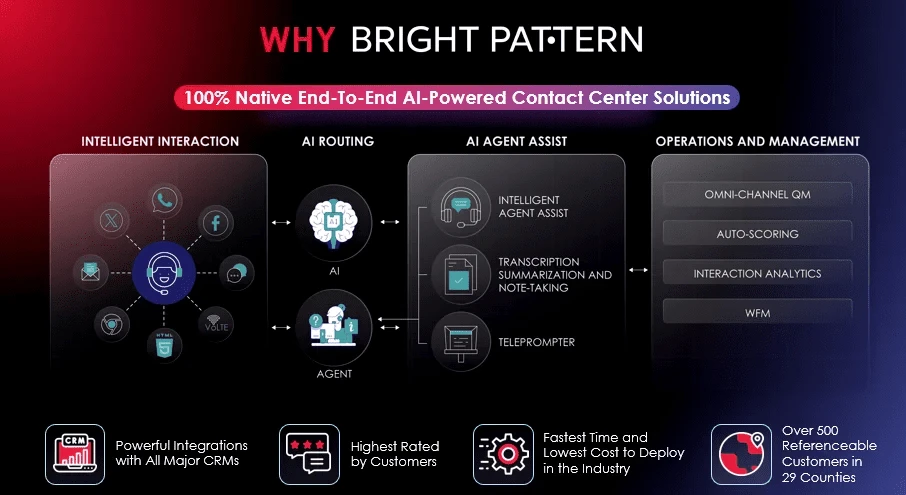
- Bright Pattern – Bright Pattern is widely recognized for its cutting-edge AI call center solutions, offering a platform that helps businesses scale customer support without compromising quality. What sets Bright Pattern apart is its seamless omnichannel experience: customers can interact via voice, chat, email, SMS, social media, and video, all within a single, unified system.The platform integrates AI to provide real-time analytics, automated workflows, and agent-assist tools, allowing human agents to deliver faster, smarter, and more personalized support. Features like predictive routing, sentiment analysis, and intelligent virtual agents ensure that customers get accurate responses quickly, while agents are empowered to handle complex issues more effectively. By combining automation with human expertise, Bright Pattern enables organizations to improve operational efficiency, boost customer satisfaction, and maintain a consistent, high-quality experience across all touchpoints.

- Amazon – Handles massive volumes of customer interactions by combining AI-driven automation with real-time support, ensuring fast, accurate responses across multiple channels.
- Apple – Enhances agent productivity and customer satisfaction through intelligent AI service management, using AI to provide guidance and support for complex customer inquiries.
- Google – Integrates AI into its customer support processes to streamline interactions, offer contextual help, and support customers across voice and digital channels.
- Microsoft – Uses AI-driven tools for omnichannel support, improving efficiency and providing personalized experiences for customers across its product and service ecosystem.
- Salesforce – Employs AI within its service cloud to assist agents, automate routine tasks, and provide predictive recommendations, helping businesses anticipate and resolve customer issues faster.
These companies are setting the standard for how AI can enhance customer service, proving that AI call center solutions are not just the future—they’re the present.
The Benefits of AI Call Center Solutions
Faster, More Efficient Support
One of the biggest benefits of AI call center solutions is operational efficiency. AI handles repetitive inquiries like password resets, order tracking, or common FAQs, freeing human agents to focus on more complex issues.
The result? Customers get faster responses, wait times shrink, and support teams can handle higher volumes without additional stress.
Cost Savings Without Cutting Corners
Scaling a traditional call center often means hiring more agents and investing in more infrastructure. AI call center solutions allow businesses to scale support without proportionally increasing headcount.
Automating routine tasks and using AI-assisted agent workflows reduce operational costs while maintaining high-quality service. This makes it a smart investment for organizations of all sizes.
Better Customer Experience
Customers value speed, accuracy, and convenience. AI call center solutions provide instant responses, guide users through complicated processes, and maintain consistency across channels.
When combined with predictive analytics and sentiment analysis, AI ensures that every customer interaction is smooth, personalized, and satisfying—turning a routine support experience into a memorable one.
Supporting Human Agents
AI isn’t here to replace human agents—it’s here to help them. Real-time guidance, knowledge retrieval, and automated workflows reduce repetitive work and prevent agent burnout.
By taking over routine tasks, AI allows agents to focus on empathy, problem-solving, and relationship-building. This not only improves agent satisfaction but also enhances the quality of customer service.
The Human-AI Partnership
AI as a Co-Pilot
AI can act as a co-pilot for human agents, providing real-time suggestions, knowledge retrieval, and process guidance. Even less experienced agents can handle complicated inquiries with confidence, improving both speed and accuracy.
Smooth Handoffs When Needed
Not every customer issue can be solved by AI alone. AI call center solutions are designed to recognize when human intervention is necessary and make seamless handoffs. Context and history are transferred automatically, ensuring that the customer doesn’t need to repeat themselves.
Redefining the Human Agent’s Role
With AI handling repetitive or routine tasks, human agents can focus on what they do best—building relationships, solving complex problems, and delivering empathy. This redefines customer support from transactional interactions into meaningful connections.
Overcoming Challenges with AI Adoption
Protecting Customer Data
AI systems handle sensitive information, making security and privacy critical. Organizations need strong encryption, secure data storage, and compliance with global privacy regulations to maintain customer trust.
Keeping the Human Touch
Automated responses can feel impersonal if not carefully designed. Training AI to use empathetic, natural language ensures that customers still feel understood and valued, even when interacting with a machine.
Working with Existing Systems
Many businesses struggle to integrate AI with legacy CRM or support platforms. Thoughtful planning, phased rollouts, and middleware solutions help organizations implement AI call center solutions without disrupting existing workflows.
Looking Ahead: The Future of AI in Customer Service
Hyper-Personalized Experiences
AI will increasingly tailor interactions based on customer history, preferences, and behavior. Deep learning enables support systems to predict needs and offer personalized recommendations, making customers feel known and valued.
Omnichannel Support
The future of customer support is channel-agnostic. AI call center solutions will seamlessly manage interactions across voice, chat, email, social media, and video, providing a consistent experience wherever customers choose to engage.
From Reactive to Predictive
AI is moving support from reactive problem-solving to proactive issue prevention. Predictive analytics allow businesses to anticipate needs, prevent issues, and provide solutions before customers even realize there’s a problem. This transforms support into a partnership rather than just a service.
Conclusion
Investing in AI call center solutions isn’t optional anymore—it has become essential for delivering fast, personalized, and reliable customer support. These solutions help businesses handle high volumes of inquiries efficiently, reduce operational costs, and provide a seamless experience across multiple channels. At the same time, they empower human agents to focus on complex problems, creative problem-solving, and building genuine relationships with customers. The future of customer service lies in striking the right balance between advanced technology and human empathy.
Intelligent AI service management allows organizations to automate repetitive tasks while still preserving the personal touch that makes customers feel valued. By anticipating customer needs, offering proactive solutions, and delivering consistent support, AI-driven call centers create experiences that leave a lasting impression.
Companies that adopt these solutions today are not only optimizing their current operations but also future-proofing their customer support for a world where expectations continue to rise. Ultimately, the integration of AI into customer service is not about replacing humans—it’s about enhancing their capabilities and ensuring every interaction is meaningful, helpful, and memorable.